

If you have ever watched your cat stare at a blank wall, sprint down the hallway for no reason, or swat your hand after what felt like a lovely petting session, you already know the truth: cats do not think like us. And that is exactly why understanding cat behavior feels so hard at first.
Dogs wear their hearts on their sleeves. Cats wear theirs on the inside, and they express it in tiny signals: a tail tip twitch, an ear rotation, a slow blink, a decision to sit one meter away instead of on your lap. Miss those signals and your cat seems moody, random, even mean. Read them correctly and your cat becomes one of the most honest companions you will ever meet.
This guide teaches you to think like a cat. Not in a cute metaphorical way, but in a practical way: what drives the feline mind, how cats greet, warn, love, and stress, and how to respond so trust grows instead of breaking. By the end, you will not just know what your cat does. You will know why, and you will know what to do next.
Let’s start where every good decoder starts: with the mistakes almost every human makes.
Why Cats Seem Impossible to Read (The Human Mistake)
Most confusion comes from one simple error: we translate cat behavior through dog logic or human logic.
Dog logic says a wagging tail is happy, so a flicking cat tail must be happy too. Wrong. In cats, a fast flicking tail usually means irritation. Human logic says a belly rub is affection, so an exposed cat belly must be an invitation. Often it is not. For many cats the belly display is a sign of deep comfort that also doubles as a defensive position, and hands that dive in get grabbed.
Cats evolved as solitary hunters of small prey, and at the same time they were prey for bigger animals. That double life shaped everything about them. Solo hunters do not need loud pack signals, so cats communicate quietly. Prey animals cannot afford to look weak, so cats hide pain and fear until they cannot. Territorial animals need predictable safe space, so cats hate sudden change more than we expect.
Once you accept those three facts, the weird behavior starts making sense. Your cat is not being dramatic. Your cat is being a cat, in a world built by humans.
The Three Rules of the Cat Mind
Every feline behavior you will ever see connects back to three core rules. Memorize these and half the decoding work is done.
Rule 1: Safety Comes Before Everything
A cat will choose safety over food, over play, over affection. If your cat hides when guests arrive, skips dinner after a move, or refuses the litter box after a new dog blocks the hallway, that is not stubbornness. That is the number one feline priority doing its job.
Practical translation: when behavior changes suddenly, ask first what feels unsafe right now. New smell? New sound? New route? New person? Changed routine? The answer is usually hiding in the last 48 hours of your home’s history.
Rule 2: Scent Is Their First Language
Cats live in a smell world we barely notice. They mark territory and family with scent glands on the head, cheeks, chin, and paws. When your cat rubs its cheek on your leg or bumps its head into your hand, that is not only affection. It is paperwork. Your cat is filing you under mine, safe, familiar.
Practical translation: respect the scent map. Heavy cleaning products, new furniture, or a new pet can erase the map and cause real stress. Keep scratching posts and rubbing spots in place, and introduce change slowly.
Rule 3: Routine Is Comfort
Cats thrive on predictability: same feeding times, same sleeping spots, same play sessions. Routine lowers stress because a predictable world is a safe world. This is also why cats wake you at the same minute every morning. You trained them, accidentally, with consistency.
Practical translation: change one thing at a time, and pair every change with something good like food or play.
How Cats Say Hello: Greeting Signals
Cats have a full greeting vocabulary, and it is softer than the dog version.
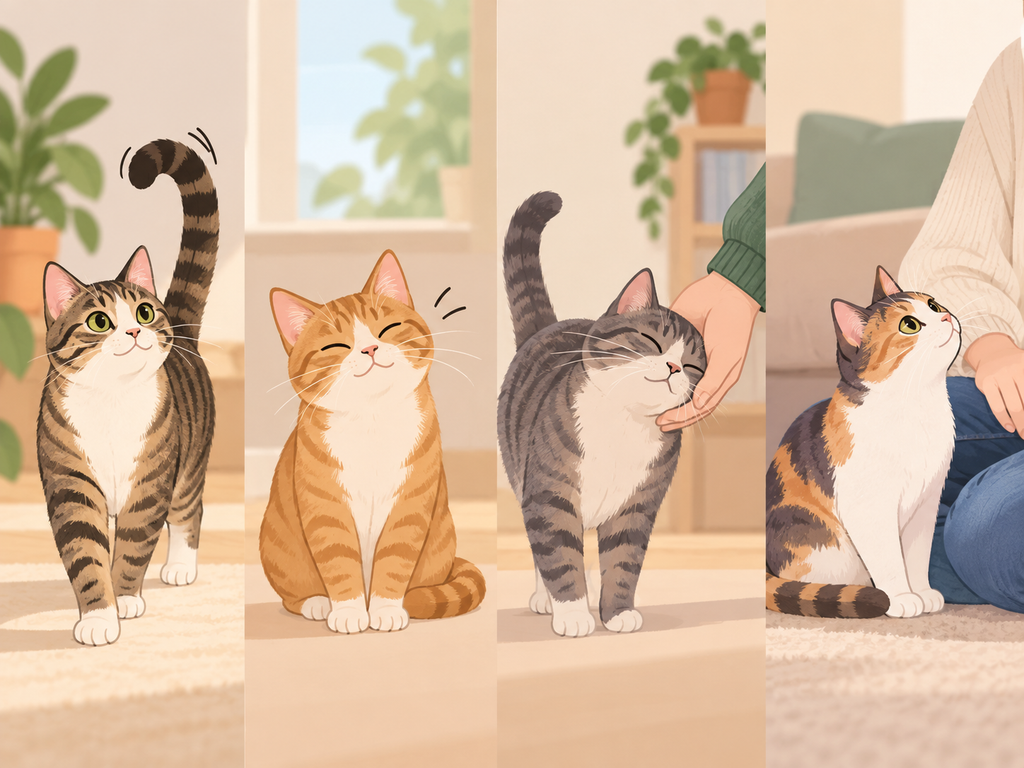
- Tail held up with a small hook at the tip: friendly and confident. This is the feline wave.
- A quick trilling chirp: excitement and recognition, often saved for favorite humans.
- The slow blink: eyes closing halfway and opening slowly while looking at you. This is trust in visible form. You can answer it by blinking slowly back. Many cats reply, and that tiny exchange is a real conversation.
- Head bunting: a gentle head bump against your cheek, hand, or forehead. Scent glands meet, scents mix, and your cat says you belong to the family group.
- Sitting near you, not on you: companionship on cat terms. Presence is affection.
Notice what is missing: jumping, licking your face, full body wiggles. Cat greetings are quiet. If you wait for dog style enthusiasm you will miss the cat hello happening right in front of you.
How Cats Say Stop: The Early Warning System
This section prevents most bites, scratches, and “my cat attacked me for no reason” stories. Cats almost always warn before they escalate. The warnings are just subtle.
The ladder usually climbs like this:
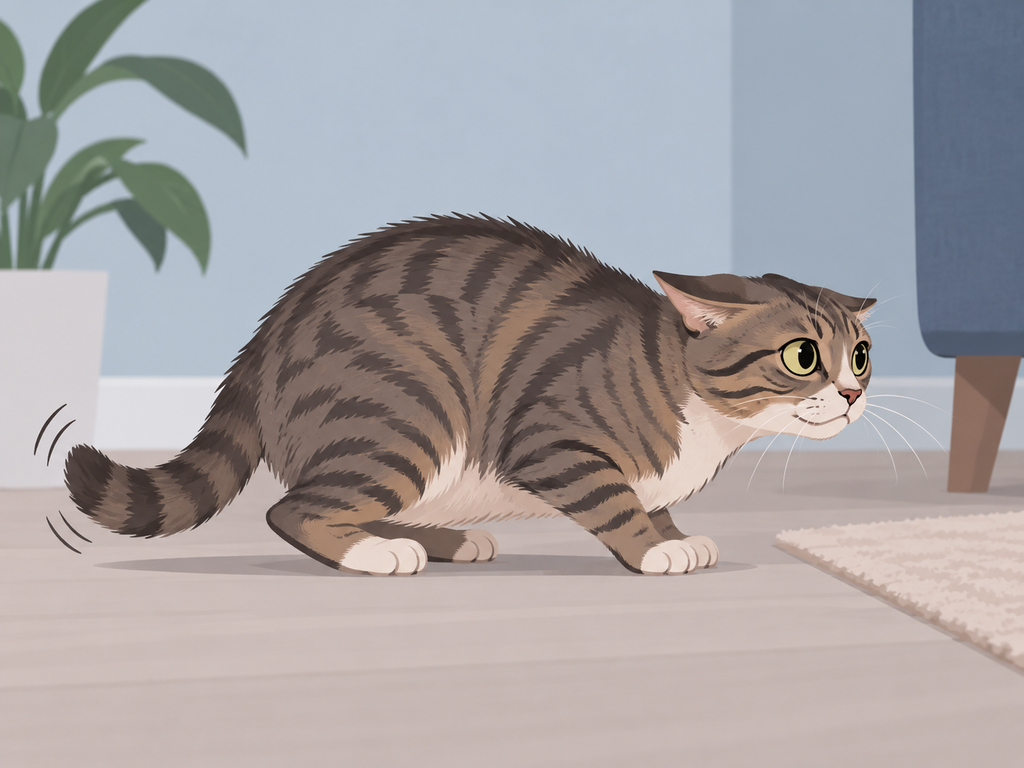
- Small signals: tail tip twitch, skin ripple, ears rotating sideways, pupils widening, head turning away.
- Clearer signals: tail thumping or fast flicking, ears flattening, body tensing, freezing.
- Vocal warnings: growl or hiss. A hiss is not rage. It is fear saying back off before I have to fight.
- Last resort: swat or bite.
Here is the part owners must understand: every punished warning gets quieter. A cat scolded for hissing learns that hissing does not work, and the next signal may skip straight to teeth. So the golden rule of understanding cat behavior is this: reward the warning by respecting it. See a flick or a flattening ear? Stop petting, give space, and let the cat choose to return. You just taught your cat that small signals work, which means you will keep receiving them instead of bites.
How Cats Show Love (It Is Not Always Cuddles)
People ask “does my cat love me?” while their cat is actively loving them in cat language.
Common feline love signals:
- Kneading you with the paws, a kitten reflex reserved for the safest place in their world
- Purring while relaxed, with a loose body and eyes closed halfway
- Following you room to room, then grooming nearby instead of climbing on you
- Sleeping on your clothes, your keyboard, or your pillow, because those spots smell like their favorite human
- Bringing you toys, which is hunting behavior shared with family
- Exposing the belly while dozing, a huge trust signal even when it is not an invitation to touch.
- Head bunting and cheek rubs, the scent based compliment
Love in cat language is mostly about trust and proximity, not contact. A cat that chooses to be in the same room as you, relaxed, is paying you a serious compliment.

How Cats Show Stress (The Quiet Signals)
Because cats hide weakness, stress rarely looks like drama. It looks like routine breaking.
Watch for these changes:
- Hiding more, or hiding in new places
- Overgrooming one spot until fur thins
- Litter box changes: going beside the box, straining, or frequent trips
- Eating less, or suddenly demanding different food
- Less greeting, less play, less bunting
- More irritability: tail thumps, hisses, swats at normal touches
- Sleeping even more than the usual feline marathon
One odd day means little. A pattern over two or three days, or any sudden dramatic shift, means act. And act in this order: vet first, behavior second. Pain and illness imitate behavior problems constantly in cats, and the kindest first move is ruling out medical causes.
⚠️ Disclaimer: This article is educational and not veterinary advice. Straining in the litter box, hiding with appetite loss, or sudden aggression deserve a prompt vet visit.
Think Like a Cat at Home: Five Daily Habits That Build Trust
Understanding cat behavior is useless unless it changes what you do. These five habits turn decoding into a better relationship.
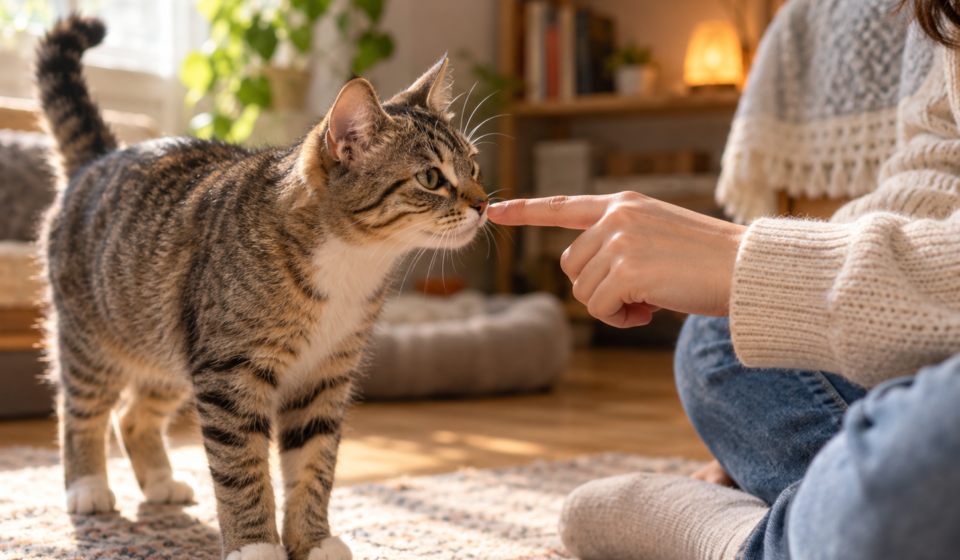
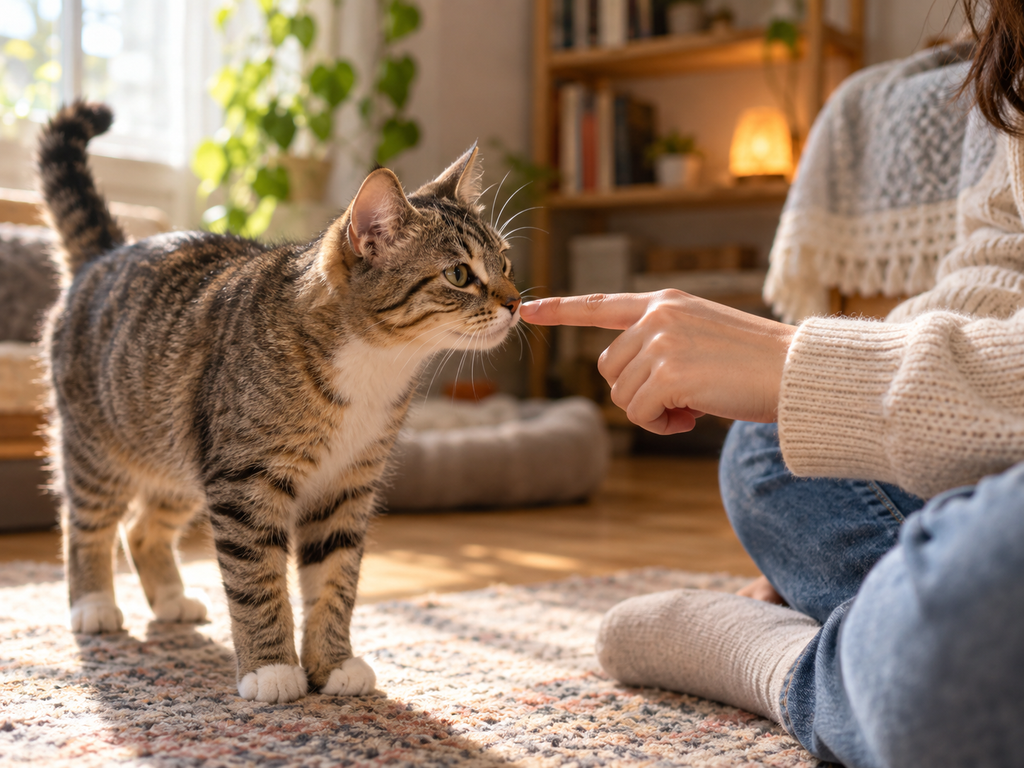
- Run the consent test. Offer one finger at nose height. If the cat approaches and rubs, pet the head zones: cheeks, chin, base of ears. If the cat stays still or moves away, the answer is no, and respecting it builds trust faster than any treat.
- Play the hunt every day. Use a wand toy to mimic prey: erratic movement, pauses, hiding behind furniture. End every session with a real catch and then a meal. Play, eat, groom, sleep is the natural feline cycle, and it fixes a huge share of nightly zoomies.
- Feed after play, at steady times. Predictable meals support Rule 3 and calm the dawn alarm clock.
- Protect the scent map. Keep scratchers, beds, and rubbing spots where they are. Add new items next to old favorites, not instead of them.
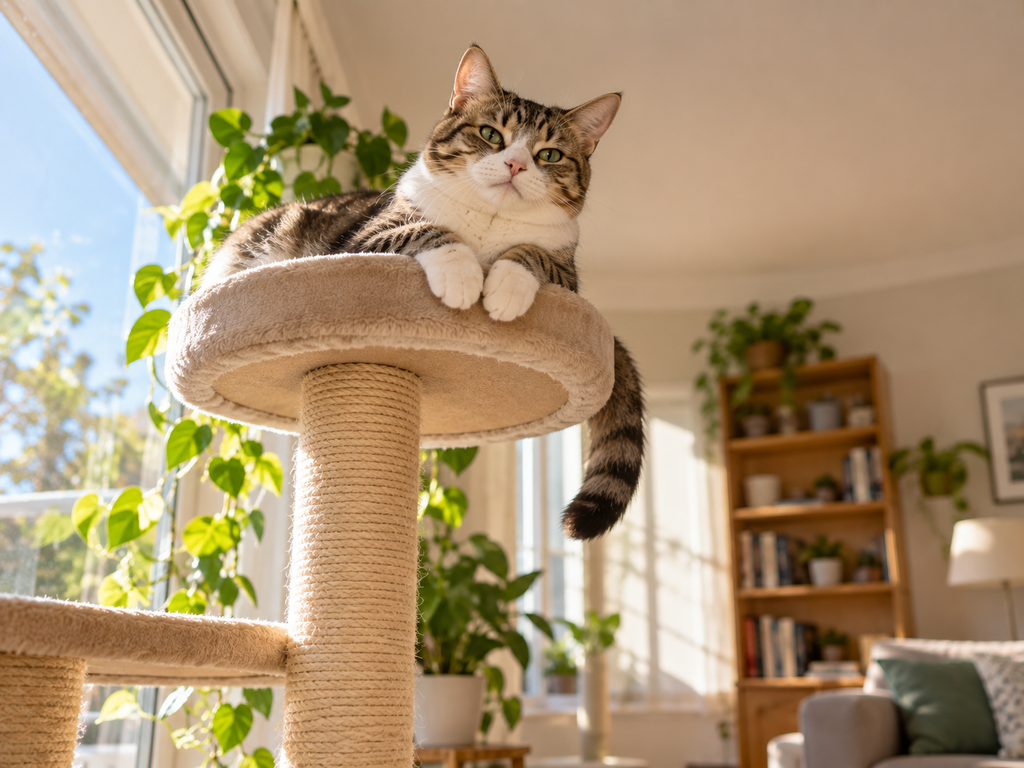
- Build up, not out. Cats feel safer with vertical space: shelves, cat trees, window perches, plus at least one enclosed hiding spot per cat. Height equals security in the feline mind.
Do these five things for two weeks and most owners notice a calmer, closer cat. Not because the cat changed, but because the human finally started speaking cat.
Common Beginner Misreadings (And the Truth)
- “My cat purrs, so my cat is happy.” Purring also appears in pain and fear. Check the body: loose and soft means content, tucked and tense means comfort me.
- “My cat showed the belly, so the belly wants rubbing.” Usually it wants nothing. Admire it like a museum piece.
- “My cat looks guilty after knocking over my plant.” Cats do not perform guilt. That lowered head and wide eyes are stress signals reacting to your angry voice, not confession.
- “My cat knocks things over to annoy me.” More likely: prey testing, boredom, or learned attention. The fall gets a reaction from you, and reactions are rewards.
- “My cat ignores me.” Cats do social roaming: near you, not on you. Ignoring would look like leaving the room. Staying nearby is company.
- “My cat hisses, so my cat is mean.” Hissing is fear asking for distance. The mean label belongs to the situation, not the cat.
Each misreading costs trust. Each correct reading deposits it. That is the whole game.
Your 60 Second Daily Decoder Routine
Once a day, glance at these five checkpoints. It takes a minute and catches problems early:
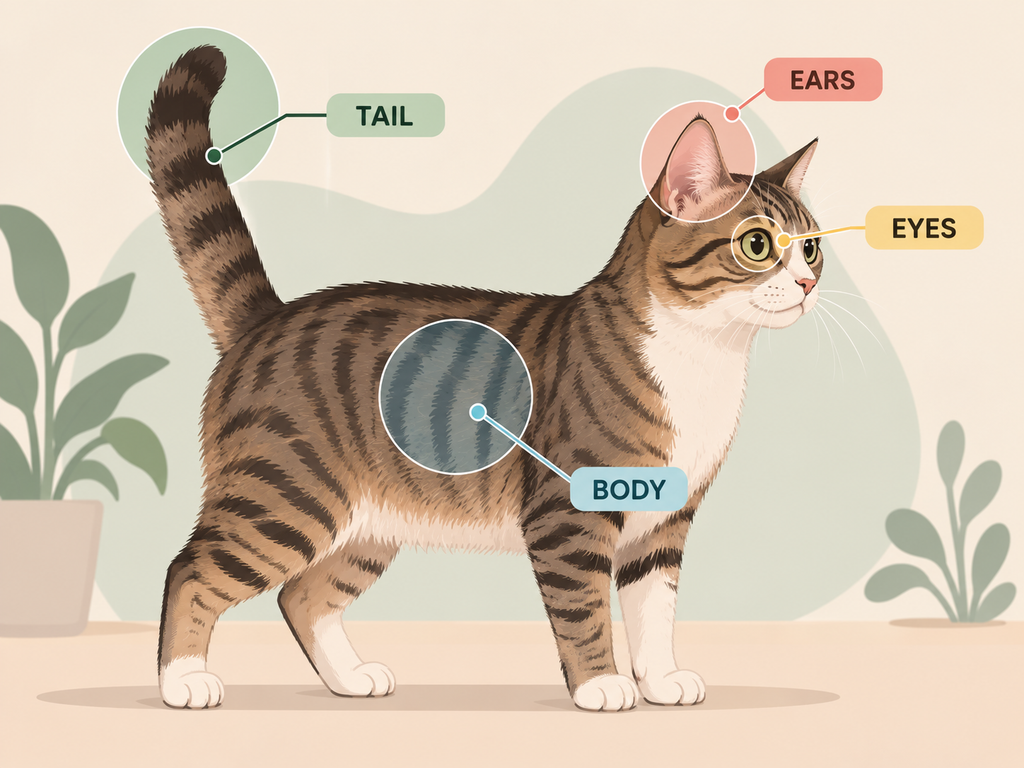
- Ears: forward and loose, or rotated and flat?
- Tail: up and loose, or low and flicking?
- Eyes: soft and slow blinking, or wide and fixed?
- Body: loose and stretchy, or tense and tucked?
- Basics: eating, drinking, litter, grooming all normal today?
Four calm signals plus normal basics means a good cat day. Two or more tense signals, or any basic going off pattern, means investigate gently today, not next week.
Understanding Cat Behavior: FAQ
How long does it take for a new cat to trust me?
Should I ever punish my cat?
Why does my cat attack my ankles in the hallway?
Is my cat mad at me after the vet visit?
Can an indoor cat really be happy?
When is a behavior change a vet issue?
Final Thoughts: The Goal Is Not Control, It Is Conversation
Thinking like a cat does not mean predicting every move. It means accepting that your cat experiences the world through scent, routine, and safety, and that every behavior is an attempt to communicate within those rules.
When you stop asking “why is my cat being difficult?” and start asking “what is my cat trying to tell me right now?”, everything softens. The swat becomes a boundary you can respect. The hiding becomes a question you can answer. The slow blink becomes a daily hello between two species that chose each other.
Understanding cat behavior is not about training a cat to be something else. It is about becoming the kind of human a cat can read easily. Do that, and your cat will meet you halfway, quietly, on cat terms, every single day.